
Unscheduled downtime costs manufacturing so much money- fifty billion dollars a year just in lost productivity. That is just the beginning. When you include things like bringing in extra help, lost materials, accidents, increased insurance premiums, or damage to a firm’s reputation, the overall cost is much higher.
Historically, factories have employed two distinct maintenance approaches. The first is known as ‘run to failure,’ and it involves waiting for a machine to break before addressing it. The second is calendar-based preventive maintenance, which consists of performing certain maintenance tasks after a predetermined period has elapsed regardless of whether the component or machine needs it or not. These methods are often cost-prohibitive and inefficient, as both are a cause of more costly repairs and production interruptions.
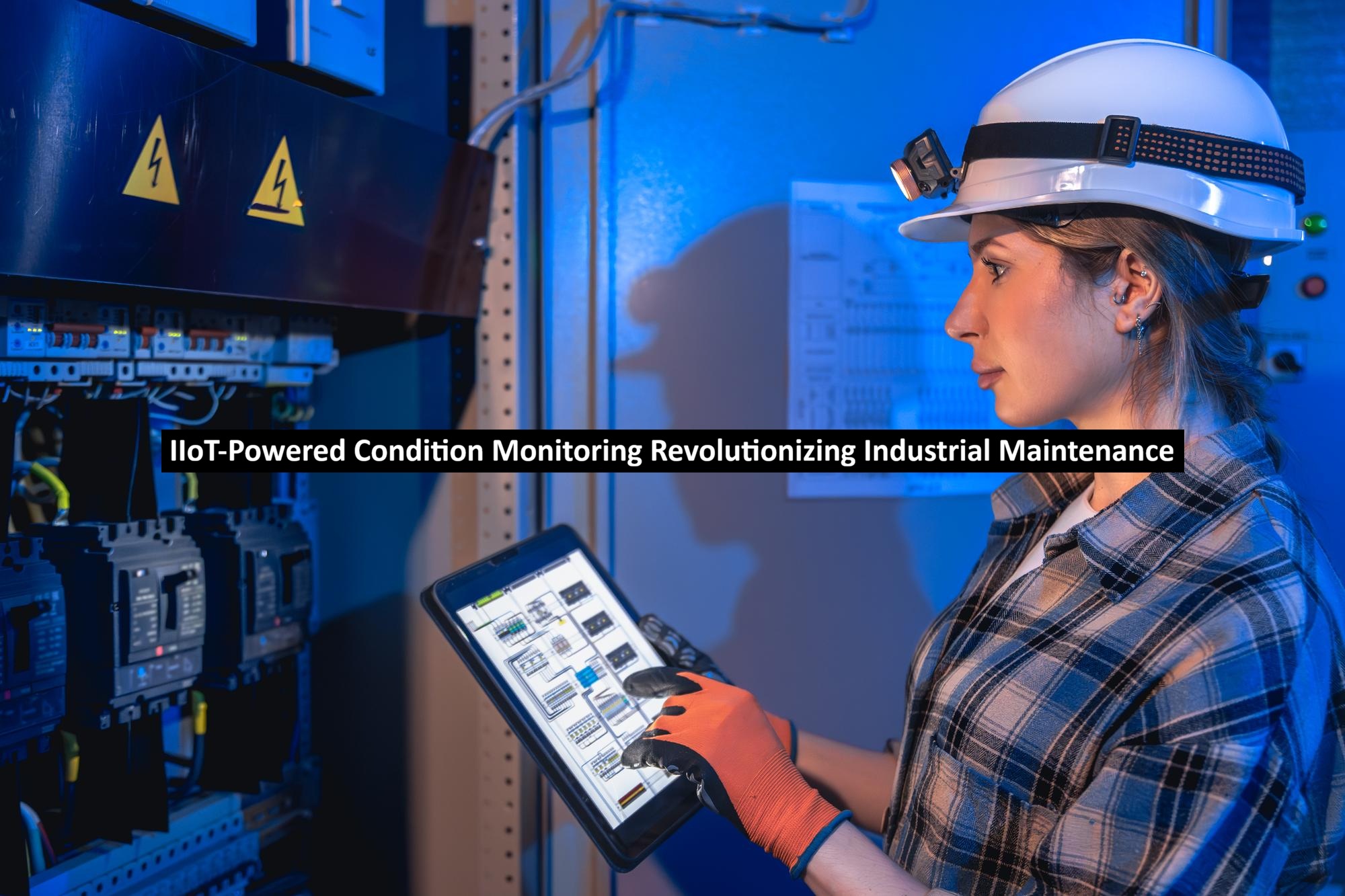
This emergence of the Industrial Internet of Things (IIoT) will revolutionize the maintenance of manufacturing facilities. Smart sensors connected to a facility will provide supervisors with constant data readings which can be used to detect a breakdown before it even occurs.

Demystifying IIoT-Powered Condition Monitoring
At its essence, IIoT condition monitoring is the constant, real-time observation of the state of your equipment using networked sensors, data analysis, and intelligent software. Instead of just waiting for the machine to break or be serviced on a fixed schedule, you are continually monitoring its true operating condition and acting only when the data says you should.
Three primary parameters constitute the cornerstone of virtually all condition monitoring efforts:
- Vibration: Anomalous vibration signatures often flag bearing wear, imbalance, or misalignment long before any failure occurs. A subtle deviation in the vibration signature from normal values can often serve as an indicator of a developing failure.
- Temperature: Increased operating temperature is a common indicator of friction, electric overload, or cooling system failure. Temperature monitoring devices are able to pick up deviations from normal temperatures many hours, and even days, before a failure of critical machinery.
- Acoustics and Ultrasound: Analysis of high frequency sounds can pinpoint bearing defects, leaks and lubrication problems in early stages of development when these condition are still unnoticeable by human ears and sight.
Together, these different data inputs can accurately define your asset condition in real-time, 24/7.
Read: Understanding the ROI of Professional Web Development: A Complete Guide
The Evolution: From Reactive to Predictive
To truly understand the role of condition monitoring, it helps to appreciate how the maintenance strategies evolved:
Reactive Maintenance: This, the most traditional approach, calls for running machinery until it breaks then fixing it. The implications of this is that machines cannot run longer than intended, other machine components may be damaged in a cascading fashion, it presents numerous safety hazards for staff, and it is expensive to initiate an emergency repair plan. In the long-run, this represents the highest maintenance cost.
Preventive Maintenance: This strategy improved reactive approaches to the machine maintenance problem by establishing planned maintenance tasks. While this eliminated catastrophic machine failure, a new inefficiency arises; components are removed at specified time intervals regardless of their operational condition, resulting in components with large amounts of useful life being taken out of service and thereby increasing unnecessary labor and costs. Reports indicate that up to 30% of all preventive maintenance is actually performed too early in a component’s lifespan.
Predictive Maintenance: As maintenance will become event-driven in the IIoT age (it will only happen when the system indicates it’s required, and not a second before or after that) that also prolongs the life of individual components and enhances machine uptimes by eliminating unforeseen stop-downs of your operation.
The Anatomy of an IIoT Condition Monitoring System
A useful IIoT condition monitoring system relies on four distinct levels:
Smart Sensors: these form the lowest layer of the stack. They are attached either to newer machines or to retrofitted older machines. They measure physical attributes, for example vibration frequency, surface temperature, acoustic signals, pressure and so on. The use of wireless sensor technology has greatly reduced the difficulty and cost of retrofitting older machines.
Edge Computing: Not all raw data from the physical sensor has to be sent directly to the cloud, but will be processed at the edge (next to the machine itself). This limits the need of bandwidth, reduces latency time significantly and enables threshold-crossing alerts in a flash.
Cloud Infrastructure: Stores the historic data, makes it possible to compare the state of machines within one plant and between several plants, and provides remote access to the assets health information from any computer. For multi-site organizations, centralized dashboards in the cloud are essential for a company-wide portfolio view of assets.
Artificial Intelligence (AI) and Machine Learning (ML): This is the “intelligence” level of the IIoT condition monitoring system. AI and ML analyze large volumes of data to find specific patterns which indicate machinery failure and allow them to produce predictive warnings which are far in advance of a breakdown. The machine learning aspect ensures the systems become more accurate over time, developing a signature of each individual machine and predicting its behaviour with greater accuracy.
The Business Value: ROI and Real-World Benefits
The argument for investing in IIoT condition monitoring is financially strong and well-documented.
Maximizing Asset Uptime: Because predictive warnings allow for a planned shutdown rather than an emergency stop to perform maintenance, lines can continue to run and are not taken offline unexpectedly, cutting the costs associated with unplanned outages.
Slashing Maintenance Costs: Predictive maintenance programs have been found, by Deloitte, to reduce maintenance costs by 25%, breakdowns by 70%, and downtime by between 25-30%. You only buy the spare parts you need when you need them, reducing the cost of spare parts inventory.
Enhancing Workplace Safety: Many large-scale failures of machines- bearings seizing or the motor burning out for example-do not occur without warning, and with the warning signs an operator could be seriously harmed. Detecting failures early provides the ability to respond quickly and ensure that no injury can occur.
Extending Equipment Lifespan: Allowing a machine to run continuously while not functioning at optimal performance, causes the further degradation of a system and over time this cumulative damage increases significantly, a preventative maintenance regime ensures that the machines do not work when not at their best and therefore a longer lifespan of assets and reduced need for new Capital Expenditures (CapEx).
Overcoming Implementation Hurdles
There are obvious challenges to overcome when adopting IIoT; addressing them frankly is key to successfully meeting them.
Legacy Equipment Integration: Most machines in operation today are not brand new, but with wireless sensors retrofitted to existing machines, the practicality of this process is not only significantly better than it was five years ago, but it has also become considerably cheaper and requires no particular technical skills to implement, as the strategy should be: start with the most critical assets and work from there.
Data Overload and Alert Fatigue: The benefit of adding sensors is to generate a mass of data. If the right algorithms are not applied, more machines will simply lead to more false positive alarms than is ever the case in manual processes. Setting threshold values intelligently and using AI driven filtering allows machines to differentiate between “alarm conditions” and “alert conditions.”
Cultural Resistance: For decades, the maintenance technician has been able to make an educated guess at the health of the machinery. Why would people of this mindset be interested in reacting on a data-based platform, when technology might put them out of a job? Overcoming this has a lot to do with letting those in control know about technology’s application; showing them how technology builds on their knowledge and experiences, and ensuring an early win with easily implementable technology.
Future Trends: What’s Next for Industrial Maintenance?
Two future-proofing technologies will influence industrial maintenance going forward.
Prescriptive Maintenance: Takes predictive diagnostics one step further and recommends actions, rather than just predicting the failure will occur at a specific time, it specifies the exact maintenance required, any required spare parts and in many cases may be linked to the ordering system of the relevant spares, removing many of the complexities of manual maintenance but allowing for human decision-making.
Digital Twins: Create a virtual simulation of an existing physical asset by processing the live data from the machines. This can then be used to analyze the effect of stress, test different configurations and analyze what would happen in the event of various forms of malfunction without risk. With improvements in data processing speed and sensor fidelity digital twins will become essential.
Conclusion
A huge paradigm shift is occurring within industrial maintenance. It is a change away from dealing with failures and towards preventing them.
IIoT condition monitoring provides the technological platform to support this paradigm shift, and it takes maintenance from being a reactive expense center into a proactive and strategic operation where efficiency, speed and data are crucial. Technology exists, is cost-effective and provides clear business advantages while the pressure from Industry 4.0 makes it imperative to implement such systems.
Consider your own maintenance capability now; determine your most vulnerable assets and pilot an IIoT condition monitoring scheme focusing on those assets and let the data decide when to move ahead to larger scale implementation. Unplanned downtime will prove costly to the business, operational resilience is its counterpoint.