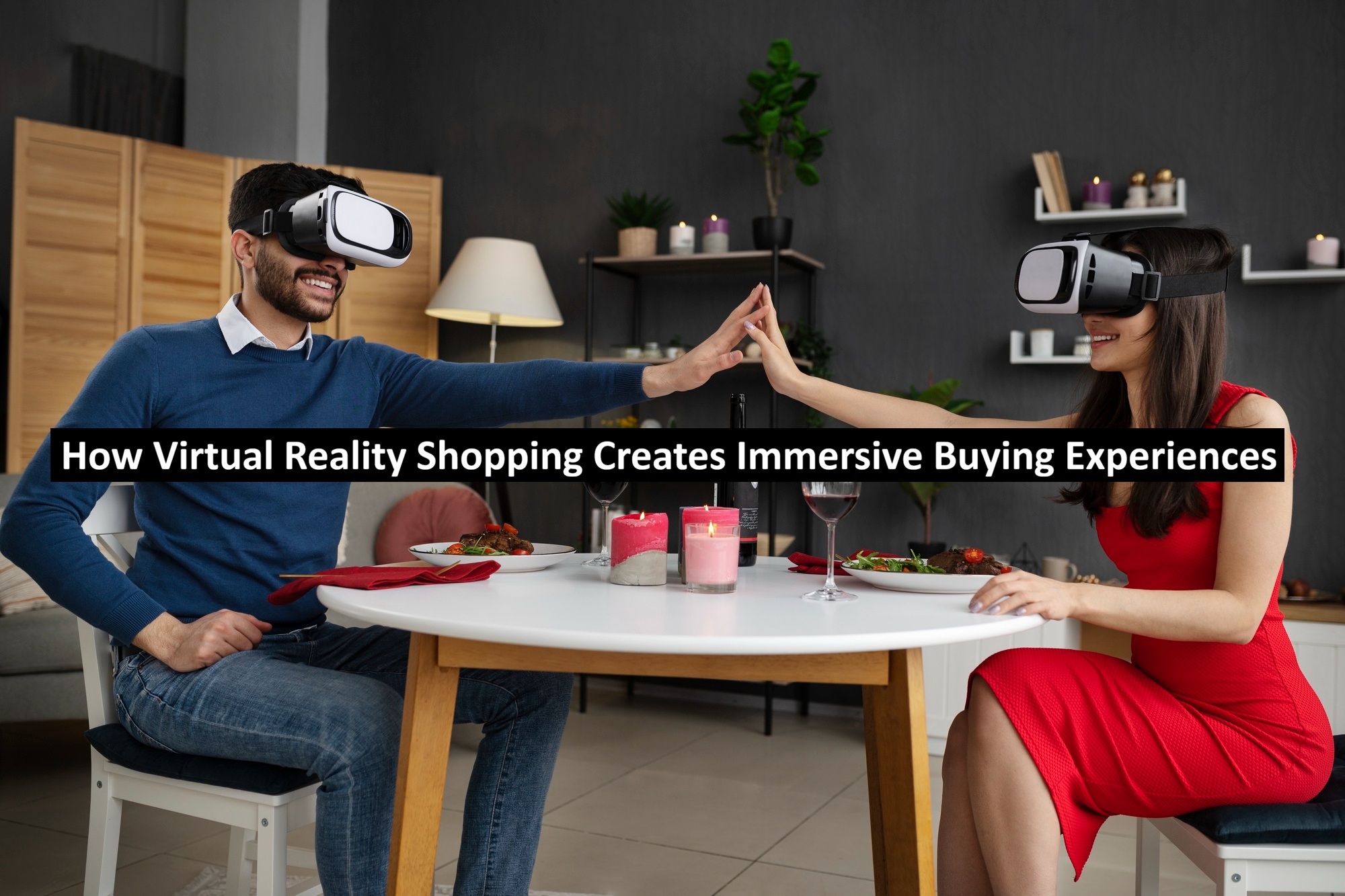
Virtual Reality Shopping is changing online product discovery and purchase methods. Customers now have the option to examine products through virtual reality, which creates real digital spaces. The results provide a better experience, which leads to improved decision-making by customers. Brands use immersive technology today to create virtual shopping experiences that combine real-world retail with additional consumer advantages.
The increasing online competition requires businesses to develop more than effective websites for their success. Virtual Reality Shopping proves beneficial because it provides users with three interactive elements that create a unified experience which feels both modern and practical. In this blog, we will learn more about how VR shopping creates an immersive buying experience for customers.
What is Virtual Reality Shopping?
Virtual Reality Shopping is an online shopping experience that lets a user explore and interact with the products within a simulated environment. The virtual reality store will provide customers with a more immersive experience of the product as they will be able to see items in a more realistic and immersive way. One of the applications can be a virtual storefront where users are able to navigate through store corridors to see products and customize their choices at the same time.
A VR retail store will provide a physical experience of shopping, and the addition of online accessibility. The shopping process allows customers to gain product knowledge, increase their level of trust, and have an immersive shopping experience that enhances their decision-making skills.
Read: Understanding the ROI of Professional Web Development: A Complete Guide
How Virtual Reality Shopping Works
It combines high-tech technologies to provide a smooth experience.
- 3D Modeling
The VR retail store is designed with high-quality visuals of the products and environments, which reflect the real-world products. - Device Compatibility
Users can explore virtual stores by using VR headsets, desktops, and mobile devices, making it more accessible for anyone. - AI Integration
A virtual reality store makes recommendations on a personalized basis depending on the way people browse and what they want. - Real-Time Rendering
Maintains smooth visuals and fast response in the process of interaction, enhancing user experience. - Cloud Support
Facilitates the scaling and enables users to view the experience at various locations without the heavy installations.
As a result, customers get a personalised and interactive shopping experience.
Why Brands Are Investing in Virtual Reality Shopping
Immersive retail is becoming the trend that businesses utilize to remain competitive and future-proof.
- Higher Engagement – A virtual reality store makes users spend more time interactively exploring.
- Global Reach – The virtual stores break geographical boundaries, hence the brands have easy access to international customers.
- Stronger Brand Value – VR retail store will place companies as innovative and progressive.
- Better Customer Insights – Organisations are able to monitor user activities within virtual worlds to enhance tactics.
- Reduced Return Rates – Improved visualization will ensure that customers choose the appropriate products, thus reducing returns.
According to the new industry insights, VR experiences are being used by international retailers throughout key shopping seasons, which underscores their increased significance.
Key Benefits of Virtual Reality Shopping
These advantages make VR an effective tool in modern retailing by enhancing customer experience and business performance.
Enhanced Product Visualization
The customers will be able to see the products in 3D views at all angles; this will give them a better idea of the design, size, and features than the non-interactive pictures.
Better Purchase Decisions
Interactive exploration assists users in making a better evaluation of the products, removes confusion, and increases confidence before making a purchase.
Convenience and Accessibility
A VR retail store gives customers the opportunity to shop at any time and from any location without necessarily having to walk to the store.
Personalized Shopping Experience
AI is used to create a virtual reality store that offers products based on user behavior to make the experience more engaging and relevant.
Higher Engagement and Retention
Virtual stores help users spend more time in the stores by making them engaging and interactive.
Improved Conversion Rates
Virtual Reality Shopping can help a business to boost sales and minimise return rate by minimising the uncertainty and maximising the understanding of the product.
Due to such advantages, it is the reason why an increasing number of brands are utilizing immersive retail strategies to remain competitive.
Real-World Trends in Virtual Reality Shopping
The adoption of immersive commerce is growing quickly across industries.
Fashion Retail
The brands are opening online virtual stores where customers can virtually try on clothes, accessories, and shoes to help them visualize how they will look on and shop.
Furniture Industry
Virtual Reality Shopping allows users to put furniture in virtual copies of their homes, and it is simple to see how it would fit and look in their houses.
Smart Retailing
A VR retail store has now built in AI-based assistants to direct users, recommend products, and enhance the shopping experience in general.
Luxury Brands
Premium brands are developing high-end virtual showrooms that recreate the in-store experiences, and they offer exclusiveness and personalized experiences.
Seasonal Campaigns
Many companies are using VR experiences at significant sales events and throughout the festive seasons in order to capture customers through interactive and engaging campaigns.
In 2025, many global brands enhanced their VR strategies during peak sales periods, showing a clear shift toward immersive retail.
Challenges of Virtual Reality Shopping
Despite its advantages, some challenges still need to be addressed for wider adoption.
- High Initial Investment – The amount of money that is needed to develop a fully functional VR platform will involve a lot of investment in design, development, and modern technologies.
- Limited Device Accessibility – Not every user owns a VR headset or a compatible device, and this can limit the immersive experience.
- Technical Complexity – Virtual environments require developers and designers with high competency to develop, maintain, and upgrade them.
- Performance and Loading Issues – The optimization can be poor, or the graphics can be heavy, resulting in slow loading time and a negative user experience.
- User Adaptation Barrier – The VR interfaces can be unfamiliar or even hard to use to some users, which will initially affect the rates of adoption.
However, as technology continues to evolve, these challenges are expected to decrease, making Virtual Reality Shopping more accessible and practical.
How much investment is needed for a virtual shopping setup?
The development of a virtual shopping experience is dependent on the complexity of the design, features, and the degree of immersion provided; this makes the cost of development change depending on these factors. Simple virtual stores of low entry level with simple navigation and less interactivity are cost-effective and can be adopted by small businesses.
Nevertheless, to have a complete virtual reality store where the 3D environment is fully fleshed out, personalization is done through AI, and interaction is made seamless, it will cost more to implement. An advanced VR retail store can also be integrated, analytical, and customized, which also adds to the costs. Thus, companies are advised to strategize on investment depending on the objectives, expandability, and customer expectations.
What types of virtual reality are used in retail?
There are usually three types of virtual reality in retail, which are categorized by the level of immersion. The first is the screen-based interaction, whereby the users navigate the virtual stores without going into a completely immersive space.
The second is the semi-immersive VR, which is more visual and more engaging, but equally relies on conventional devices. The third is complete immersion VR, where a user goes into a VR retail store with the use of headsets and works within a full VR store environment. These alternatives enable the companies to embrace Virtual Reality Shopping depending on its availability and technological preparedness.
Conclusion
Virtual Reality Shopping is revolutionizing customer-brand engagement in the digital age. It involves a combination of convenience and real-world experience, where the user is able to browse the products in such an interactive manner. It creates trust in the traditional online shopping that lacks realistic visualization and interaction. Companies are moving toward virtual stores and immersive environments to enhance customer interactions and achieve better outcomes.
Despite the issues such as cost and accessibility, technological progress is turning VR into a more viable reality that can be used by many. Virtual Reality Shopping is not only bound to improve e-commerce in the next few years, but will transform it entirely, providing more interactive, personalized, and powerful experiences both to the customers and brands.
Author’s Bio:
Charu Sharma is a technical content writer at Abhiwan Technology, specializing in Virtual Reality Shopping and emerging technologies. She writes on AI, AR/VR, Metaverse, chatbot solutions, and game development, while also covering services like UI/UX design, 3D product modeling, metahuman creation, and XR development.